Recently, I realized that there is no one version of a city. Of course, I’d heard it said before: so many different authors, so many stories. But it hadn’t struck me, not affected me; I never thought about the other facets, so they weren’t there.
I’ve lived all my life in Delhi. Since I joined college I’ve been commuting by the bus, and anyways, the road is for everyone. So I did see the poor, the working class, the informal sector. Sometimes I admired them, for they never let an opportunity for moneymaking pass. There are people who get on the bus at one stop, hawk their wares (Delhi maps, sets of pens, pencils, tablecloths, lighters) and get off at the next one. What I’m trying to say is: I wasn’t unaware. Maybe I was just uninterested.
This last winter I learned about the Genda Phool Project. Himanshu Verma, an art curator, had launched it to ‘save the phool mandis’ of Delhi. When I heard that he was looking for some help mapping the flower markets, I volunteered. We explored the Meharauli, Fatehpuri and the Connaught Place mandis. Again, I saw the people, loved the experience, the hustle and bustle and feel of the informal markets. But I wasn’t sure about the project. After all, what was so wrong about shifting them all out of the city into a brand new, swanky flower mall?
Slowly, I understood. These were real people, and this would affect their lives (and of those connected to them) in ways I couldn’t even contemplate: economics, the commute, the supply, loss of customers. But the worst realisation of all was that I couldn’t answer the question: Why were they being moved?
I’d always trusted the administration, the politicos and the ‘experts’. When the demolishing of all the illegal colonies and unauthorized commercial activity was going on, I thought, good. They deserve what they’re getting; the Master Plan says they can’t be here, so how can they be here? But now that the band-aid had been ripped off, I suddenly saw the other side.
The mandi people were making an honest living, occupying MCD/DDA space, yes, but they weren’t obstructing anything; rather, they were giving life to a dead zone. The Plaza in front of the State Emporiums on Baba Kharak Singh Marg is idle at all times, except those three-four hours every morning when India’s largest phool mandi brings it alive. And moving them out would serve no purpose, besides making Delhi even more antiseptic and sterile, seemingly ‘world class’. Does world class mean losing its own identity, becoming more linear and ‘city’ like, while pushing all that make it different from New York and Shanghai under the carpet? Slowly, we were losing our urban heritage; these mandis were just a small part of a larger agenda. We were too busy with “what will foreigners think?” to understand that if we ignore all that gives us character we might just lose our appeal. An older Times of India campaign shouted ‘Delhi: from walled city to world city.’ Why couldn’t we have both?
The seminar we organized for Utopia this year, Delhi Dallying, on the imageablity of Delhi, and a Delhi 2050 discussion I subsequently attended, both reinforced this opinion. The speakers again brought to life this other part of Delhi, the labouring poor, who, I realised, were cogs in the framework of Delhi. Without them, while the city might not come to a stop, it would certainly lose most of its steam. The informal sector engages with the city on so many dimensions that we only see the tip of the iceberg. Surely, if I could realise this, so could the bureaucracy. I was left wondering: did people genuinely not care, or was it just a ‘not in my backyard’ mentality? Certainly all of this was happening not because of the ‘hostility of the poor, but because of the hostility of the rich’. There was this ‘class war’ being fought in the city without my knowledge. I wanted to know: Why can’t we be more inclusive, more accepting?
The kabadi bazaar in front of Red Fort has already been moved, and the Darayagnj book market has just barely been saved from a similar fate. I don’t know about the kabadi bazaar, but I’ve explored the book market (and discovered some amazing finds), and I know that it’s a brilliant use of space. Darayganj is closed, and would have been empty on Sundays, if not for this. Even all these weekly sabzi markets that pop up, they all add value, identity and meaning to the areas they occupy. They give character, and of course, there are the issues of energy efficiency and economics and reducing the number of middle men. Do we really want to replace all the sabzi mandis with malls, all the phool mandis with malls, the book market with malls?
Most of us would probably answer a vehement no!. I realize now that we’ve been asking the wrong questions. It’s not ‘What do people think? Do they care? How do you make them want to care?’ as much as ‘This is what is happening, the full and the whole of it. What do you think?’
The problem is, we’re never asked.
Wednesday, March 23, 2011


Sunday, November 21, 2010
Acoustic Design of a Recording Studio
Building Sciences and Services project with Ammani Nair.
Again, thanks to Gaurav, Nikhil and Akshay! Sorry for all the bother.
An Architect
Part of a Theory of Design project. Profile and critique of the work and design philosophies of architects Robert Venturi and C.P. Kukreja.
***
This one's not really done- the portfolio list isn't even close to completion and the case study's not the best either. But since the 'design party' is on Thursday...
Tuesday, November 2, 2010
A Tale of Two Cities: Bhopal
Like Amma said, our attempt to make it big.

Short film about our experiences in Bhopal during our class trip. NOT the final cut, there's still some work left (minor editing, improving the sound quality, correcting the title, etc). But we decided to put it up because we have no idea when all of that that will get done.
Presenting:
A Tale of Two Cities: Bhopal
And YES, we've called ourselves the Archifellas. Obviously, a play on A Capella. We're really proud of the soundtrack :) Wrote the lyrics, made the music (no instruments!), though the style is obviously inspired by the Madhya Pradesh tourism ads.
The Archifellas are:
Ishan Khan
Maulik Yagnik
and me :)
Sunday, October 24, 2010
Gangtok
Holiday homework for Theory of Settlements. Group project with N. Navneethakrishnan.
***
My dad's family also moved to Sikkim during the trade boom. They've been there since the early 1930s, maybe before
Wednesday, October 6, 2010
Near Hauz Khas

Planned to explore the Hauz Khas monuments today. But a last minute movie plan (Dabang, fun, but only if you don't think) meant that my brother and I only had time to explore the Deer Park and Green Park monuments.
Deer Park is on the way to Hauz Khas village, on the right of the road leading in from Aurobindo Place market. The Green Park monuments I'm talking of are at the beginning of this road, right next to the market.

Deer Park is actually a jungle, interspersed with seemingly random jogging tracks and infinitely more random exercise bars and balancing beams and other 'fitness' equipment. And it's full of insects. A word of advice: either wear full length clothes, or apply insect repellent. Otherwise you'll end up like I did, with a couple of dozen bites all over my arms and legs.
There are three tombs in the forest, and even though I had Lucy Peck's brilliant 'Delhi: A Thousand Years of Building' to guide me, we wasted precious time trying to find them.

1. Bagh-i-Alam ka Gaumbad, late 15th to early 16th c., supposedly one of the finest Lodi tombs in Delhi. And it was pretty impressive, though unfortunately the interior was inaccessible, and there seemed to be nobody around who would open the gates for us. Peeking in through the bars revealed the beautiful inside of the dome- it's got some awesome plaster work. The tomb also had a 'wall mosque' adjoining it - just a wall on the west side with a mihrab. The sign says that its roof had probably fallen in.

2. Tuhfewala Gumbad, 14th c. Pretty plain. Some guys were playing tash inside and blasting Akon and Justin Bieber. Baby baby baby oooooh.

3. Kali Gumti, 14th c. Small. And black.
I was disappointed that there were no signages leading to the tombs or even ASI information boards (barring ones for the small wall mosque near Bagh-i-Alam and the Kali Gumti). These monuments were obviously poorly maintained, and slightly vandalized, but honestly, they still had charm, shrouded as they were in greenery.
***


We took one of those Vodafone e-ricks back to Aurobindo Place. There are actually 6 monuments in this area, but one of them (Biran ka Gumbad, late 15th c.) is some distance inside Green Park, and since we were really running late we had to miss out on it. These are different from the Deer Park tombs because they are very much maintained. Every one of them has an ornate sign outside and a detailed information board with drawings. They also have some pretty fancy lighting.

1. Choti Gumti, late 15th c. Very, very small. But exceedingly pretty. The cream plaster was beautiful.

2. Sakri Gumti, late 15th c. Literally 'narrow dome', easy to understand why. Most probably a gateway and not a tomb. An old man was sleeping inside, complete with jute mat and water bottle and slippers left outside.

3. Barah Khamba, 14th c. Dome supported by twelve pillars of varying sizes. I remember our History of Architecture teacher telling us that there are many Barah Khambas in Delhi, not just the one which gives Barakhamba Road its name.

4. Dadi ka Gumbad, late 15th c. Big, and very impressive.
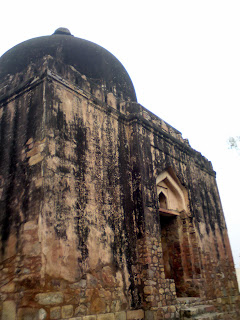
5. Poti ka Gumbad, late 14th c. Right next to the Dadi ka Gumbad, and so seems even smaller. The Dadi-Poti Gumbads, though very close together, have nothing to do with each other and the names have no real history. I guess they just represent the sizes.
***
Had fun, but am sorta disappointed about not getting to see what I really went there for: the Hauz Khas complex. Dunno when I'll next get the time.
Tuesday, October 5, 2010
Nehru Memorial

Slept away the first few days of the holidays. But I was really bored today, so when I read that the Nehru Planetarium has organized a sky show on Subrahmanyan Chandrasekhar, I dragged my brother to the Teen Murti Bhavan to see it. The complex (huge, around 45 acres) houses the Nehru Planetarium, the Nehru Memorial Museum and Library, and the auditorium. It's called Teen Murti because of a group of three statues, a WWI memorial to soldiers from Mysore, Jodhpur and Hydrabad. The main building, a classic example of colonial architecture, is designed by Robert Tor Russel, who also designed CP. It was built in 1929-30 as the residence of the Commander-in-Chief of the British Indian Army, and after independence, in August 1948, it became the official residence of PM Jawaharlal Nehru. After his death in 1964 it was converted into his memorial.
We went to the Planetarium first. Outside there are a series of pretty awesome educational exhibits, some interactive, on astronomy and the universe, although some don't really work. But they really do explain seemingly difficult concepts easily. They were facing some problems with the Chandra movie, and so they screened 'The Ultimate Universe' instead. This was my first time in a planetarium, and it was brilliant! The movie, about the universe in general, was great and really informative, though slightly too long and boring. The visuals were amazing, and the whole experience was almost 3D.
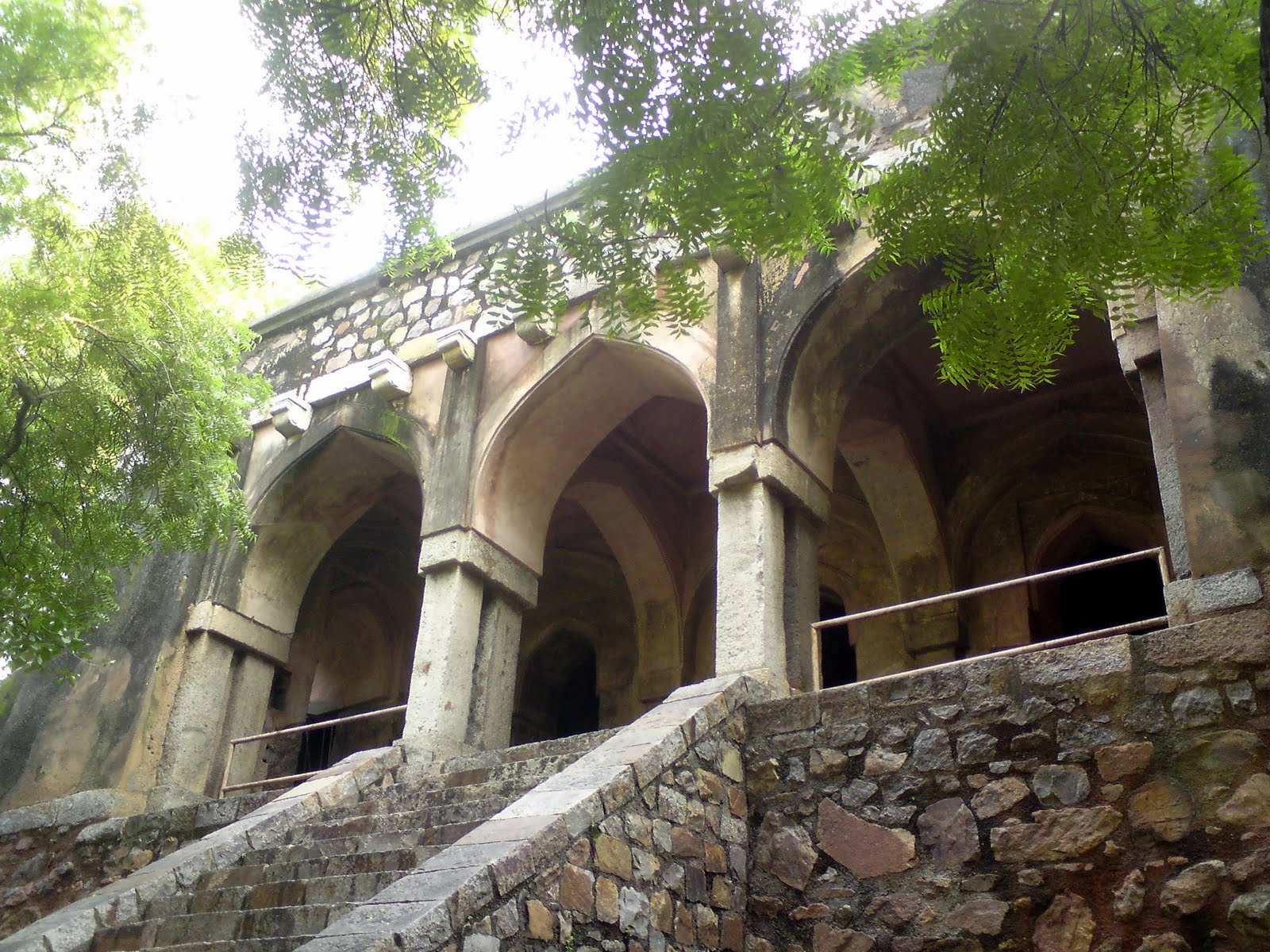
Very surprisingly, right outside the planetarium, and part of the complex, is a protected monument! The Kushak Mahal was built by Feroze Shah Tughlaq as a hunting lodge. Quaint and surrounded by greens, it's really one of the lesser known monuments of Delhi -I can't even find an appropriate link!


The museum was boring, and most galleries were old and not really maintained. There was a new exhibit called 'Nehru, the Architect of Independent India', which was better, though honestly, still boring. The recorded speeches were interesting. One you had to listen to the normal way, on headphones, but for the other one (Nehru announcing Bapu's death), you lifted the receiver of one of those old-style telephones. Pretty charming. Since it's a personalia museum, parts of the Teen Murti House -the sitting room, study, and Nehru's and Indira's bedrooms- have been preserved. These were also great, and shit! the amount of books they had. The best bit about the museum, though, was undoubtedly the recreated Central Hall of the Parliament as on 14/15 August, 1947 midnight. There are figures of the speaker, and all these people, GB Pant, BR Ambedkar, C Rajagopalachari, etc., at least 12-13 of them, sitting on the benches, all listening to an animated figure of Nehru, complete with head and eye movements, delivering the 'Tryst with Destiny' speech. You could sit with all of them and listen. It was awesome.
We also went to the auditorium, where they had a play going on, which, sadly, we were too late for. The building is nice, one of those which bridge the inside and the outside. Our next stop, the nearby canteen, was pretty dark and dingy, but mostly because greenery covers all the windows! Really weird.
I enjoyed the day, and the planetarium was amazing, but, like I said, I was disappointed with the museum. And considering that it's a stop on the HoHo bus tour as well, I expected better.
P.S. The Nehru Memorial Museum and Library has a whole host of events lined up during the CWG. Unfortunately, I won't be in Delhi for most of them. Damn :/
Update, 06/11/11:
You can read more about the complex in The Modern Architecture of New Delhi: 1928-2007, a brilliant little book. Discovered that the architect of the Teen Murti Bhavan extensions is Padma Shri Mansinh M. Rana, erstwhile Chief Architect of the NDMC.
Update, 06/11/11:
You can read more about the complex in The Modern Architecture of New Delhi: 1928-2007, a brilliant little book. Discovered that the architect of the Teen Murti Bhavan extensions is Padma Shri Mansinh M. Rana, erstwhile Chief Architect of the NDMC.
Subscribe to:
Posts (Atom)